CERAMICS FROM A LABRADOR INUIT SOD HOUSE IN ST. MICHAEL’S BAY

The recovered ceramics all reflect a contact scenario with the French whose fishing vessels plied the waters of southern Labrador from the early sixteenth century until 1763. This pottery may have come directly to Labrador from France, or it may have arrived on French ships that were first supplied at major ports in eastern Canada such as Placentia, Louisbourg, or Quebec City. Found between 2009 and 2012, the ceramic types reveal a chapter in Labrador Inuit history that predates English colonial presence. The sherds are predominantly from the Normandy region of France and include stoneware, faience blanche, and faience brune. Also represented are the remains of two vessels from the Beauvaisis, also a Saintonge jug neck and rim that may represent the early part of the site’s settlement, and an English-made salt-glazed stoneware plate or soup bowl with bead and reel rim decoration that represents the more recent end of the settlement spectrum. The time frame represented by the ceramics ranges from the mid-1600s to the mid-1700s.
(Scale in all images is 5 cm; Photos by C. Arbour, M. Stopp, K. Wolfe)
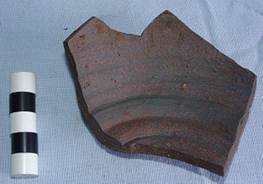
Stoneware vessel base and body section from the Domfront region, Normandy, France. (FeAx-3:222)
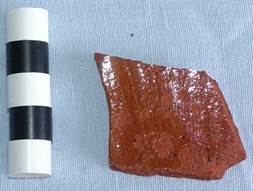
Lead glazed red earthenware body sherd of a thin-walled vessel.
(FeAx-3:220)
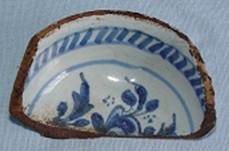
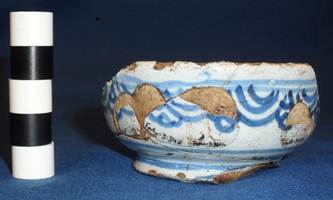 Tin-glazed earthenware
bowl (outside and interior views). Normandy blue on white
common ware. (FeAx-3:151)
Tin-glazed earthenware
bowl (outside and interior views). Normandy blue on white
common ware. (FeAx-3:151)
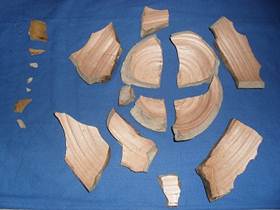
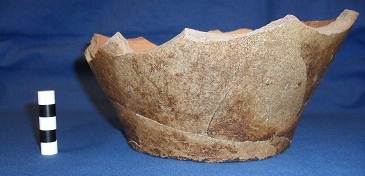
Stoneware jug base from Beauvaisis region, Normandy, France. Found inside one of two stone cache features within the Inuit sod house (fragments and repaired views). (Identification courtesy of M. Arcangeli, U of Boston, Mar. 2012). (FeAx-3:286)
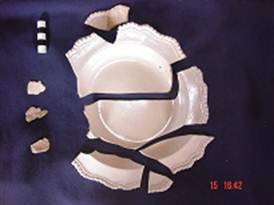
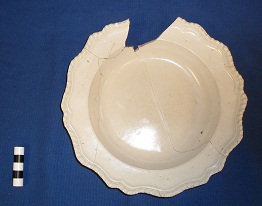
Bead and reel decorated salt-glazed stoneware plate or soup bowl. An English ware but widely
used in the French colonies of Canada such as at Louisbourg and Place Royale (Quebec City). These shards were all found together in the second stone cache (fragments and repaired views). (FeAx-3:266)
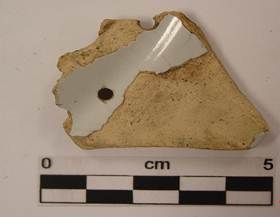 Normandy
Plain tin-glazed earthenware with two drilled holes for vessel repair. (FeAx-3:104)
Normandy
Plain tin-glazed earthenware with two drilled holes for vessel repair. (FeAx-3:104)
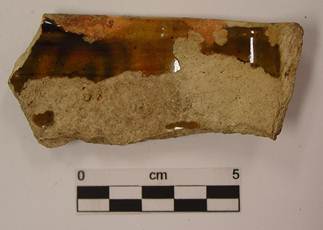 Lead-manganese glazed
interior surface, probably faience brune pottery. Exterior surface retains no glaze.
(FeAx-3:105)
Lead-manganese glazed
interior surface, probably faience brune pottery. Exterior surface retains no glaze.
(FeAx-3:105)
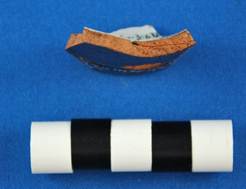 Profile
of Normandy faience brune
vessel, where glaze has been preserved on both inside and outside surface. White tin-glaze on interior, brown lead-manganese
glaze on exterior. (FeAx-3: 672)
Profile
of Normandy faience brune
vessel, where glaze has been preserved on both inside and outside surface. White tin-glaze on interior, brown lead-manganese
glaze on exterior. (FeAx-3: 672)
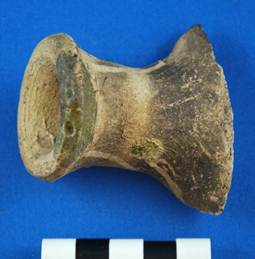
Rim, neck, and shoulder of a spout reminiscent of “gourdes,” or small portable bottles. Body of vessel is not perfectly spherical but appears to be somewhat flattened. Saintonge (Identification courtesy of M. Arcangeli, U. of Boston, Mar. 2012). (FeAx-3:736)
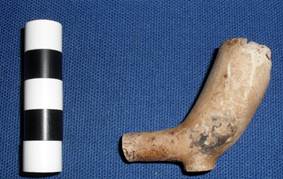 Pipe bowl
resembling types dating from ca. 1680-1770 in Hume (1974). (FeAx-3:367)
Pipe bowl
resembling types dating from ca. 1680-1770 in Hume (1974). (FeAx-3:367)