CLOTHING ORNAMENTATION FROM A LABRADOR INUIT SOD HOUSE IN ST. MICHAEL’S BAY

Personal ornamentation was a hallmark of Inuit culture in Labrador and the eastern Arctic. It ranged from bodily tattoos to objects applied to clothing. With increased contact, objects of European manufacture were adapted as ornamentation. Brass was shaped into headbands, and beads were made into elaborate ear pendants [see the Inuit portraits in Stopp 2009]. Somewhat unusual objects such as spoon bowls and coins were also adapted as clothing ornamentation.
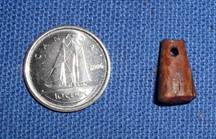 An
ivory or tooth pendant. (FeAx-3:281)
An
ivory or tooth pendant. (FeAx-3:281)
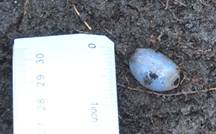 Lavender-hued, wound,
glass bead, probably type WIc2 in Kidd and Kidd (1972). K. Karklins
(pers. comm. Sept. 2011) notes that this type of bead is sometimes called a
“pigeon egg” and has a date range of 1670-1869 and a period of high use ca.
1740. (FeAx-3:165)
Lavender-hued, wound,
glass bead, probably type WIc2 in Kidd and Kidd (1972). K. Karklins
(pers. comm. Sept. 2011) notes that this type of bead is sometimes called a
“pigeon egg” and has a date range of 1670-1869 and a period of high use ca.
1740. (FeAx-3:165)
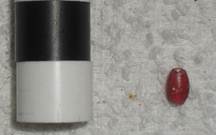 A tiny
bead resembling Kidd and Kidd (1972) IVa4, redwood colour with light grey
interior. (FeAx-3:402)
A tiny
bead resembling Kidd and Kidd (1972) IVa4, redwood colour with light grey
interior. (FeAx-3:402)
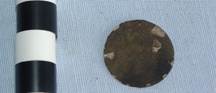 Two such coins were found. A small drilled
hole at the top edge suggests that it served as a pendant, probably sewn onto
clothing. This coin was known as a double sol, a “30 denier” or “deux livres” and was made for the
colonies of “billion” or copper/silver alloy. It dates to 1710-1713.
(FeAx-3:159)
Two such coins were found. A small drilled
hole at the top edge suggests that it served as a pendant, probably sewn onto
clothing. This coin was known as a double sol, a “30 denier” or “deux livres” and was made for the
colonies of “billion” or copper/silver alloy. It dates to 1710-1713.
(FeAx-3:159)
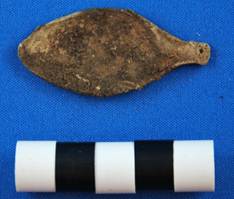 Two such spoon bowls were
recovered. Note the small drilled hole at the stem base. Karlis
Karklins in Trade
Ornament Usage Among the Native Peoples of Canada
(pg. 197) illustrates how spoons were used by Inuit women to decorate their amautis. (FeAx-3:575)
Two such spoon bowls were
recovered. Note the small drilled hole at the stem base. Karlis
Karklins in Trade
Ornament Usage Among the Native Peoples of Canada
(pg. 197) illustrates how spoons were used by Inuit women to decorate their amautis. (FeAx-3:575)